
Understanding Breech Styles, Bolt Clearances, and Casing Support
Posted by Pristine Technologies on 2026 Aug 20th
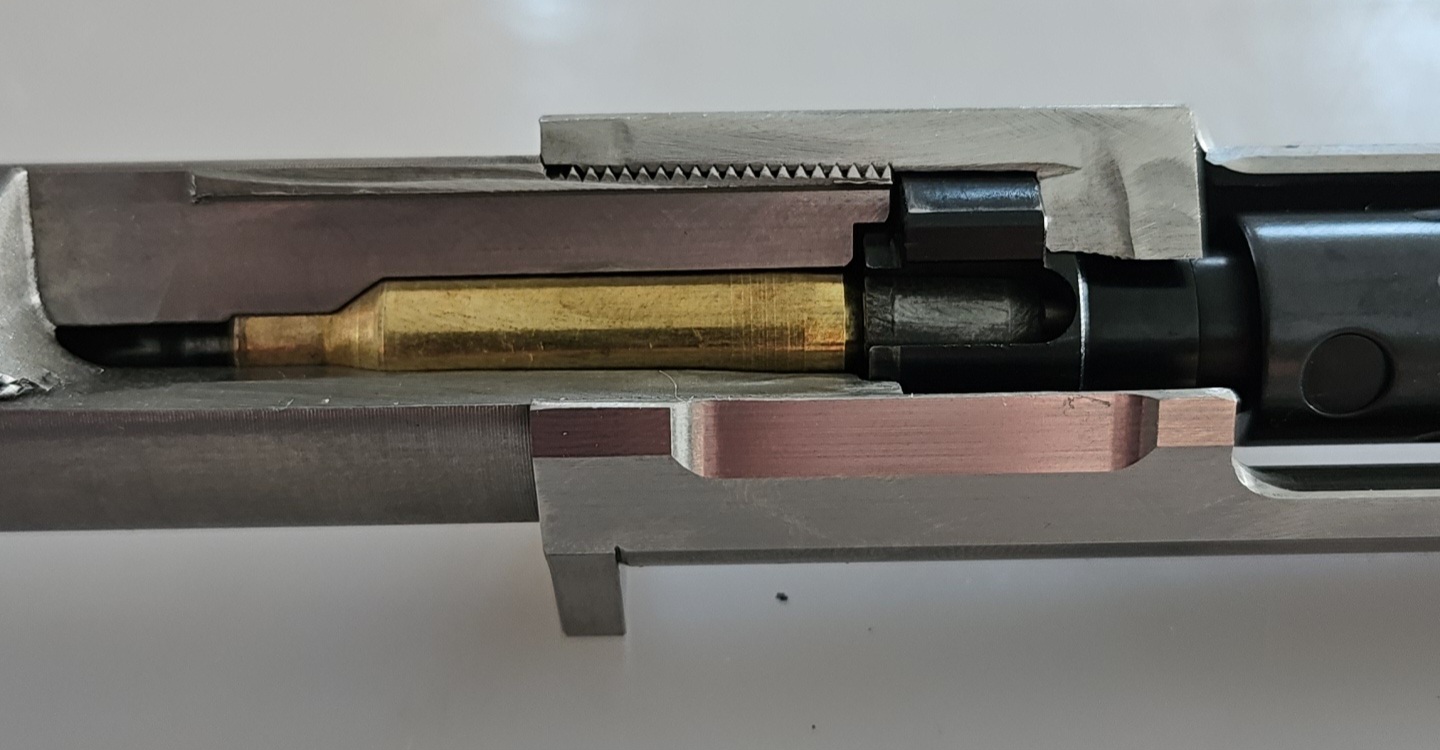
When barrel makers and gunsmiths chamber a barrel for a bolt-action rifle, the geometry at the breech face—where the barrel tenon meets the receiver—is a critical interface. While several breech styles exist across the industry, the goal of this article is to go over a few details regarding the Remington-style counterbore used on Pristine TWO LUG actions. This gets a bit technical and covers details that primarily matter to gunsmiths and barrel manufacturers, but understanding how these components interact is still a great concept for any rifle enthusiast to know when planning a build or learning how their firearm operates under pressure.
Why Breech Cuts Matter
Upon ignition, burning propellant generates internal chamber pressure, the brass acts as a gas seal; it is thin and flexible, meaning it relies entirely on the surrounding steel of the chamber and bolt face to contain those forces. The breech cut dictates how the barrel, bolt head, and receiver align to contain that pressure.
The Remington-Style Counterbore & "Three Rings of Steel"
One of the more widely recognized breech design in modern bolt actions is the recessed counterbore, commonly referred to as the Remington-style breech.
How it works:
-
A cylindrical pocket (counterbore) is machined directly into the rear face of the barrel tenon.
-
The forward nose of the bolt features a corresponding step-down diameter that sits nested inside this barrel pocket when the bolt is closed and locked.
Why it's used: This design creates three concentric layers of solid steel wrapping around the cartridge case head:
-
Ring 1: The recessed bolt face surrounding the case head.
-
Ring 2: The barrel counterbore wall surrounding the bolt nose.
-
Ring 3: The receiver ring surrounding the barrel tenon threads.
In the event of an overpressure situation, the overlapping steel rings help channel high-pressure gas away from the shooter's face and out through designated vent ports in the receiver.
Bolt-to-Breech Clearances: Why They Are Necessary
Manufacturer tenon prints specify exact depths and diameters for the breech counterbore, but these dimensions are designed with important clearances in mind.
Key Clearance Factors:
-
Radial Clearance: The gap between the outer diameter of the bolt nose and the inner diameter of the barrel counterbore.
-
Face Clearance: The gap between the front face of the bolt nose and the floor of the counterbore.
Why clearance is required: While tolerances must remain precise for alignment, the bolt nose must never make hard contact with the bottom or sides of the counterbore when the action locks up. If these clearances are cut too tight, tiny particles of unburned powder, carbon buildup, field dirt, or natural thermal expansion during firing will cause the bolt to drag or bind. Proper clearance allows the action to cycle smoothly under real-world conditions.
Case Protrusion and Total Casing Support
Across different action designs (such as flat-breech, cone-breech, or recessed counterbore setups), the distance the cartridge extends out of the rear of the chamber—known as case protrusion—will vary. However, the foundational engineering rule across all breech styles remains the same: the cartridge casing must be fully supported by the chamber wall up to its solid web.
What happens without proper support: The wall of a brass cartridge transitions from thick, solid brass at the base (the web) to thinner brass along the body. If too much of the thin body brass protrudes unsupported past the chamber mouth into the breech counterbore:
-
The unsupported brass will expand past its yield point upon ignition.
-
This leads to case head separation, blown primers, or catastrophic gas leakage into the action.
Ultimately, while breech styles and counterbore depths vary by action design, maintaining specified bolt-to-breech clearances while ensuring complete casing support inside the chamber is what keeps a rifle cycling smoothly and operating safely.