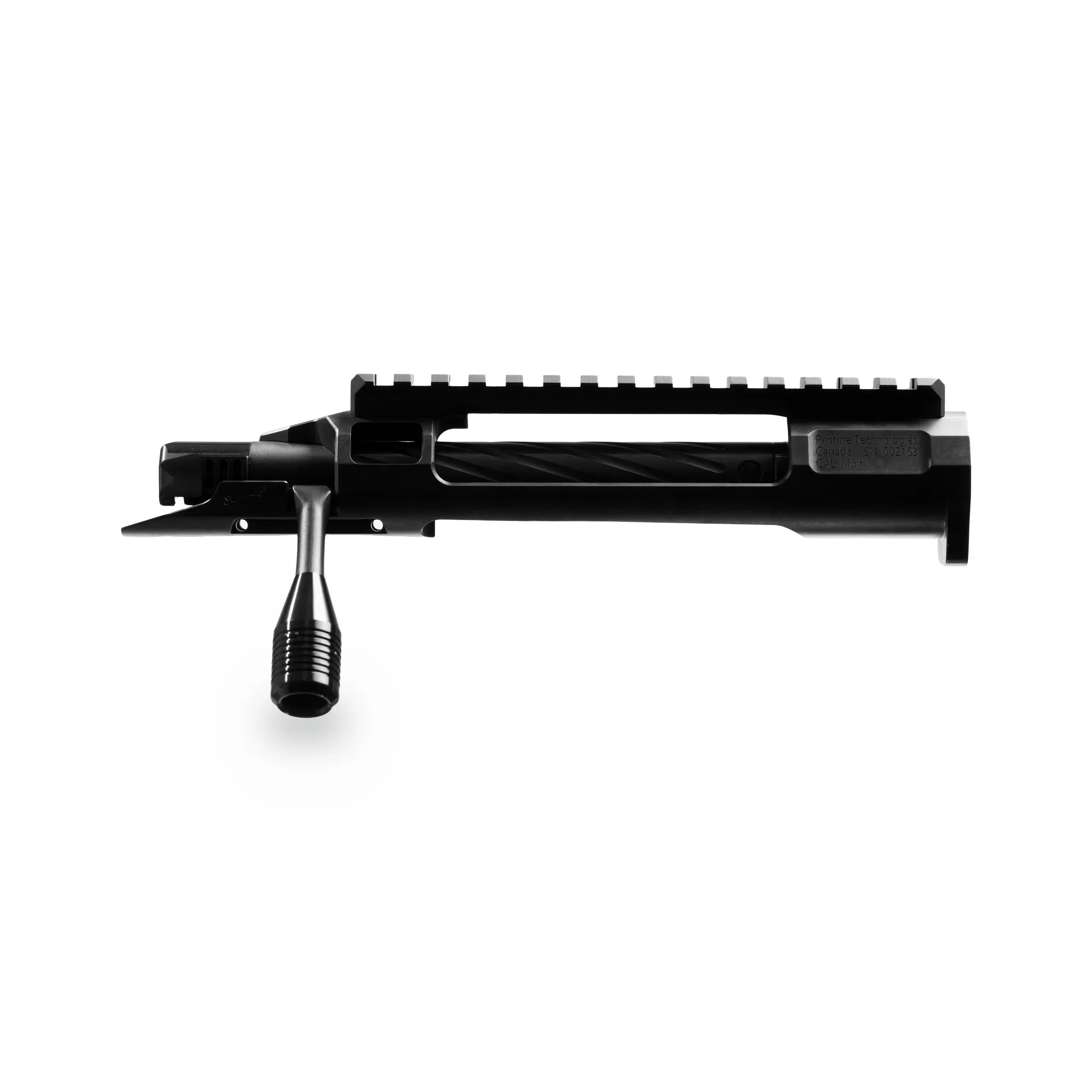
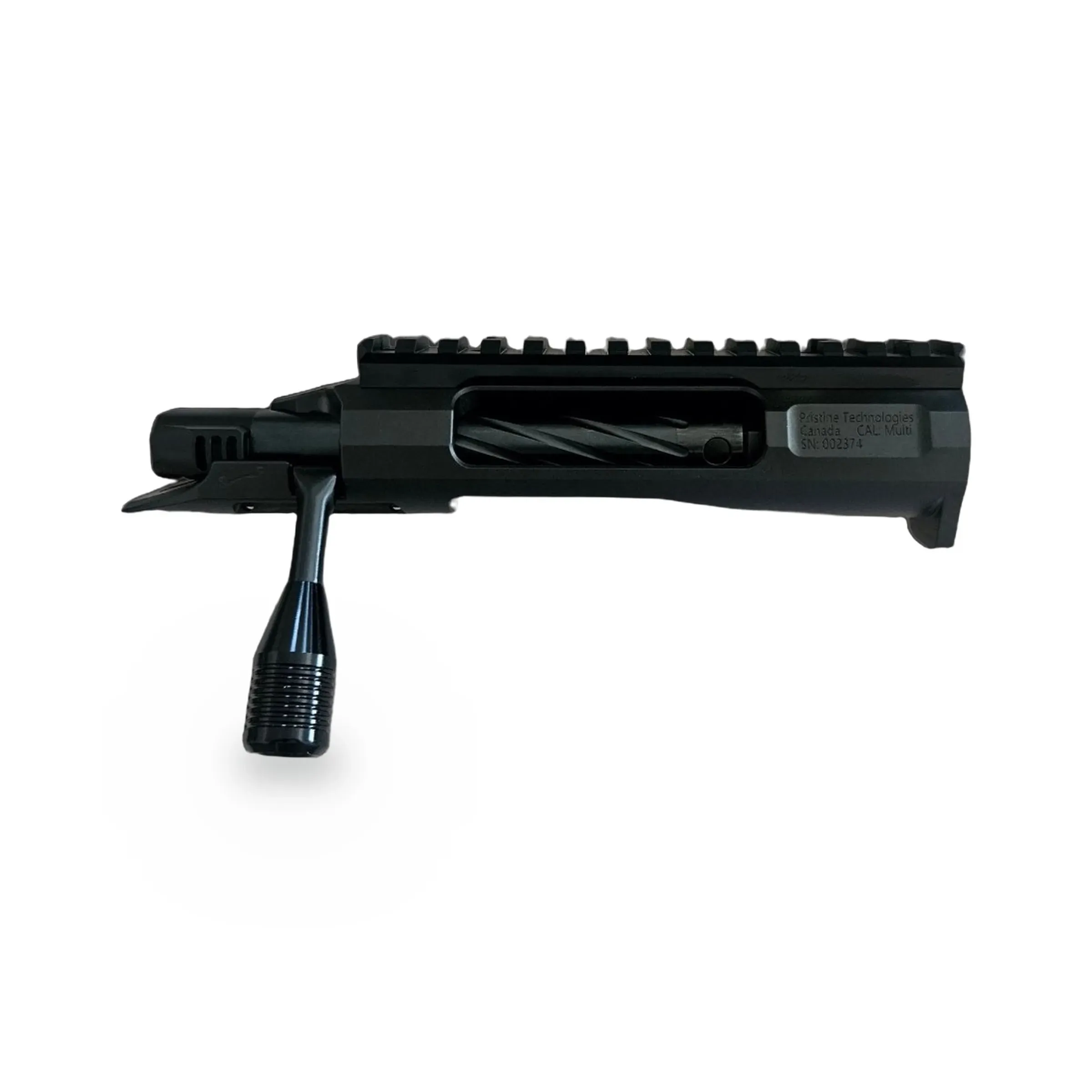
If you're shopping for rifle actions, sooner or later you hit the same question we get on the phone all the time: is a custom action actually worth it over a factory Remington 700? The short answer is that a custom rifle action buys you consistency. You're paying for tighter machining, a bolt that fits the receiver properly, a recoil lug and scope rail that are part of the design instead of add-ons, and small parts like the extractor and ejectors that are built to work every time. A factory action can be made to shoot, but it usually takes a gunsmith's time to get it there.
That doesn't mean everyone needs a custom action. If you're building a deer rifle that will shoot a few boxes a year inside 300 yards, a good factory action can do the job. Where custom bolt actions earn their price is when you're shooting a lot, stretching the distance, running a match rifle hard, or planning to rebarrel down the road and want a platform that stays the same through every barrel.
We build precision rifle actions on the Remington 700 footprint in our shop in Fort Macleod, Alberta, and ship them across Canada and to the United States. So we have a bias, and we'll own that. But we also build and shoot a lot of rifles, and we'd rather you buy the right thing than the expensive thing. Here's how we look at it.
What a rifle action actually does
The action is the heart of a bolt rifle. It holds the barrel, carries the bolt, locks up behind the cartridge when it fires, feeds from the magazine, holds the trigger and gives your scope something solid to mount to. Every other part of the rifle bolts to it or sits in it.
That's why the action matters more than people give it credit for. A great barrel screwed into a receiver that isn't square, or a bolt that wobbles in its raceway, or a scope base that shifts under recoil, will cost you accuracy no matter how good the barrel is. On the other hand, a solid action doesn't make a rifle accurate on its own. It gives the barrel, the ammo and the shooter a consistent starting point, and it keeps things consistent shot after shot.
When we talk about what you pay for with custom rifle actions, it really comes down to one word: consistency. The same lockup every time, the same feed and ejection, the same scope mount after a hard day in the truck, and the same platform after your third barrel.
Factory Remington 700 vs a custom action: where the money goes
The Remington 700 is the most copied action pattern out there for good reason. It's simple, strong, and there's a huge aftermarket of stocks, chassis, triggers and bottom metal built around it. That footprint is exactly why we build our actions to it.
The trouble with factory actions in general is that they're built to a production cost and a production tolerance. That's fine for a hunting rifle off the shelf, but it's why "blueprinting" or "truing" a factory action became a common gunsmithing job. A smith squares things up, fits the bolt, laps the lugs and sorts out the recoil lug before the build can really shine. You pay for that time on top of the action, and at the end you still have the factory bolt face, extractor and scope mounting.
Here's where the money goes on a custom action instead.
Machining and bolt fit
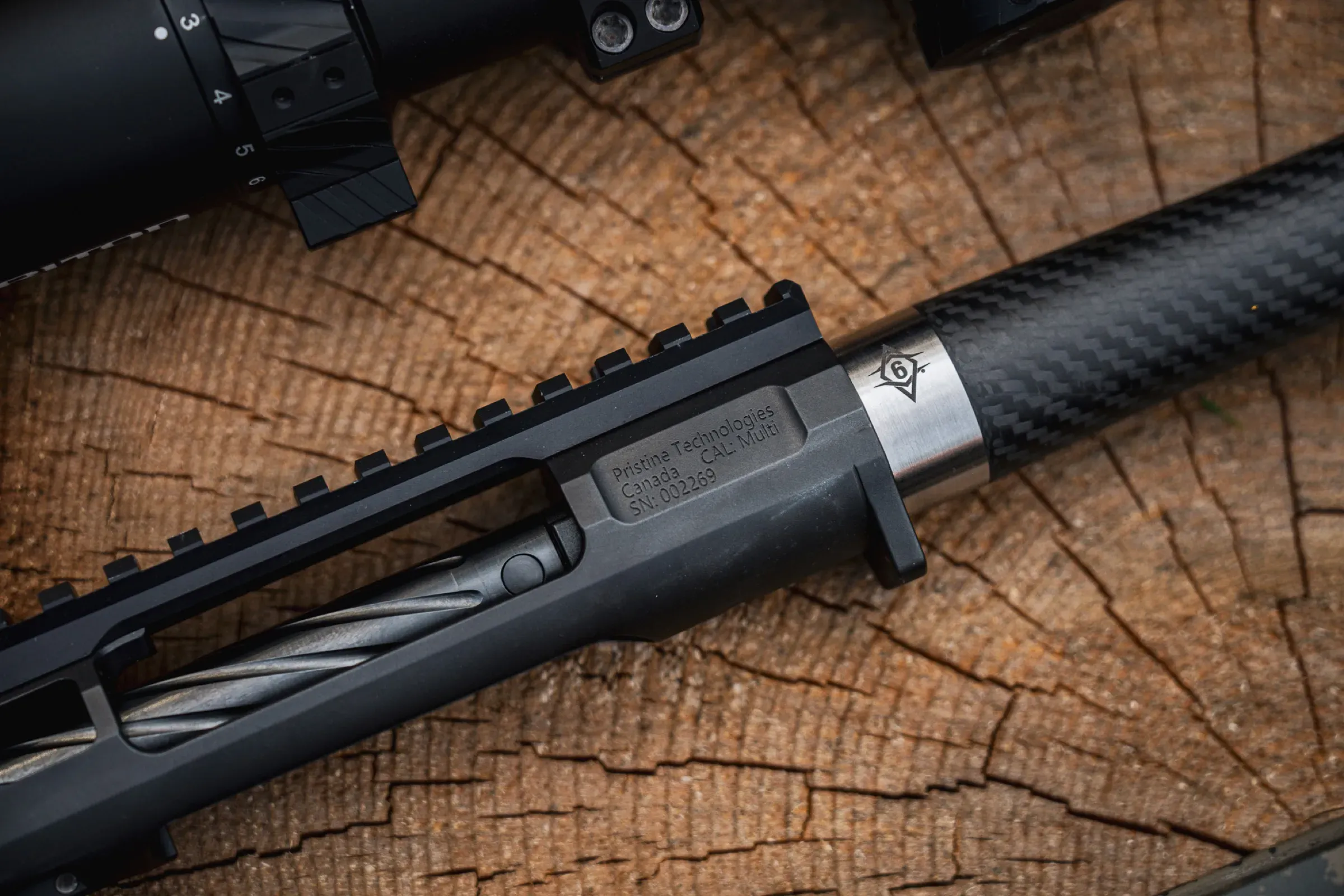
A custom action is machined so the critical surfaces line up from the start: the threads, the bolt raceway, the lug abutments and the face of the receiver. The bolt is fitted to the receiver so it runs straight and locks up the same way each time. On our Lightweight actions, the bolt raceway is cut with Wire-EDM, which is a big part of why the bolt runs so smoothly. Every action we make is machined, fitted and checked in our shop by the same people who designed it.
You feel this the first time you run the bolt. Owners describe our bolts as smooth as glass. Smoothness isn't just a nice feeling. A bolt that runs clean lets you cycle without disturbing the rifle on the bipod, which is a big deal when you're trying to spot your own hits in a PRS stage.
Floating, interchangeable bolt heads
On most factory actions, the bolt face is machined right into the bolt body. If you want to go from a 6.5 Creedmoor to a 6.5 PRC, you're looking at a new bolt or a gunsmith opening up the bolt face.
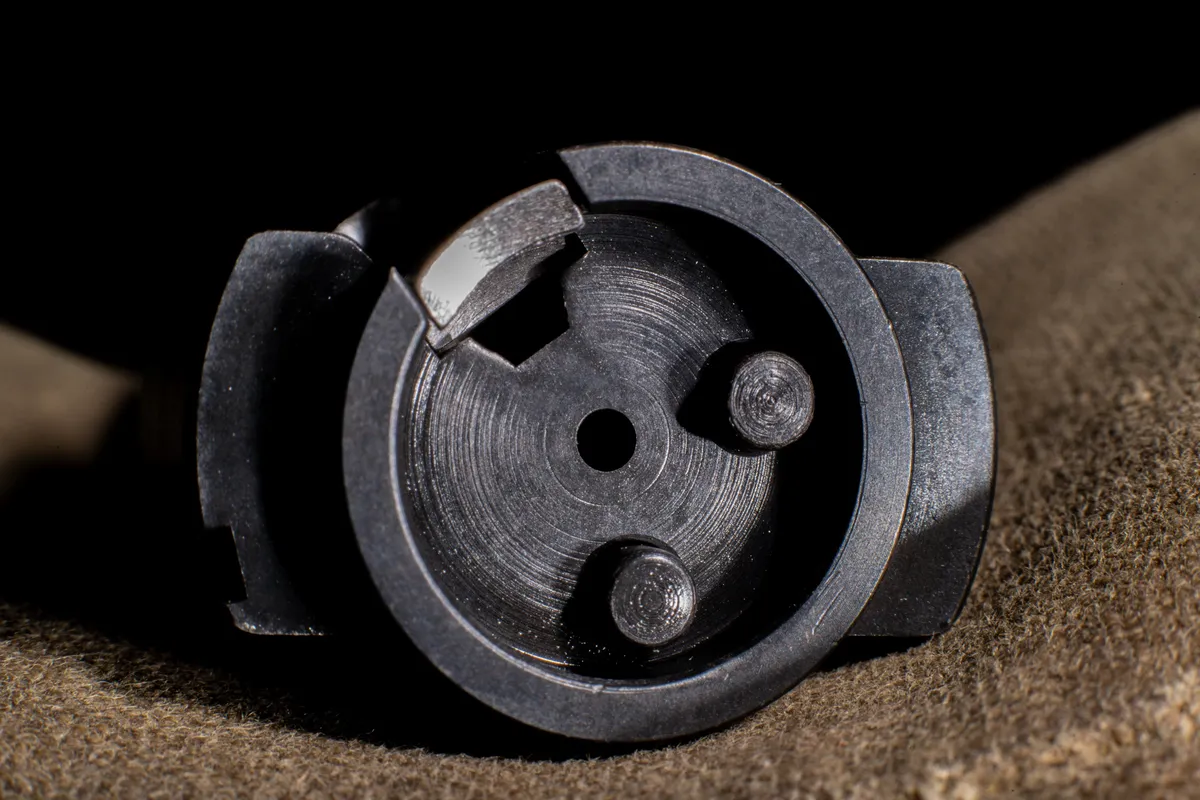
Our actions use floating, interchangeable bolt heads, on both the two-lug and multi-lug platforms (Magnum and Lapua faces are on our two-lug actions). The bolt head is a separate part that can be swapped, so moving to a different cartridge family means a new bolt head, not a new action. The floating design lets the head sit and lock up evenly against the receiver. We cover the swap step by step in our bolt disassembly and bolt head swap video, and if you're not sure which face you need, our bolt face guide lays it out by cartridge.
Keep in mind a bolt head swap only deals with the rim of the case. You still need a barrel headspaced to that bolt head and a magazine that suits the cartridge.
Integral vs pinned recoil lug
The recoil lug is what transfers recoil from the action into the stock or chassis. On a lot of factory 700-pattern rifles, it's a separate washer-style lug clamped between the barrel and the receiver. It works, but it's one more part that has to sit square, and it gets disturbed every time the barrel comes off.
Our Lightweight and Heavy actions have an integral recoil lug, machined as part of the receiver body. There's nothing to line up during a barrel change, and it takes a variable out of the build. Our Classic actions use a pinned recoil lug instead, which is located by pins so it goes back in the same place every time. Both are a real step up from a loose lug.
A pinned Picatinny rail
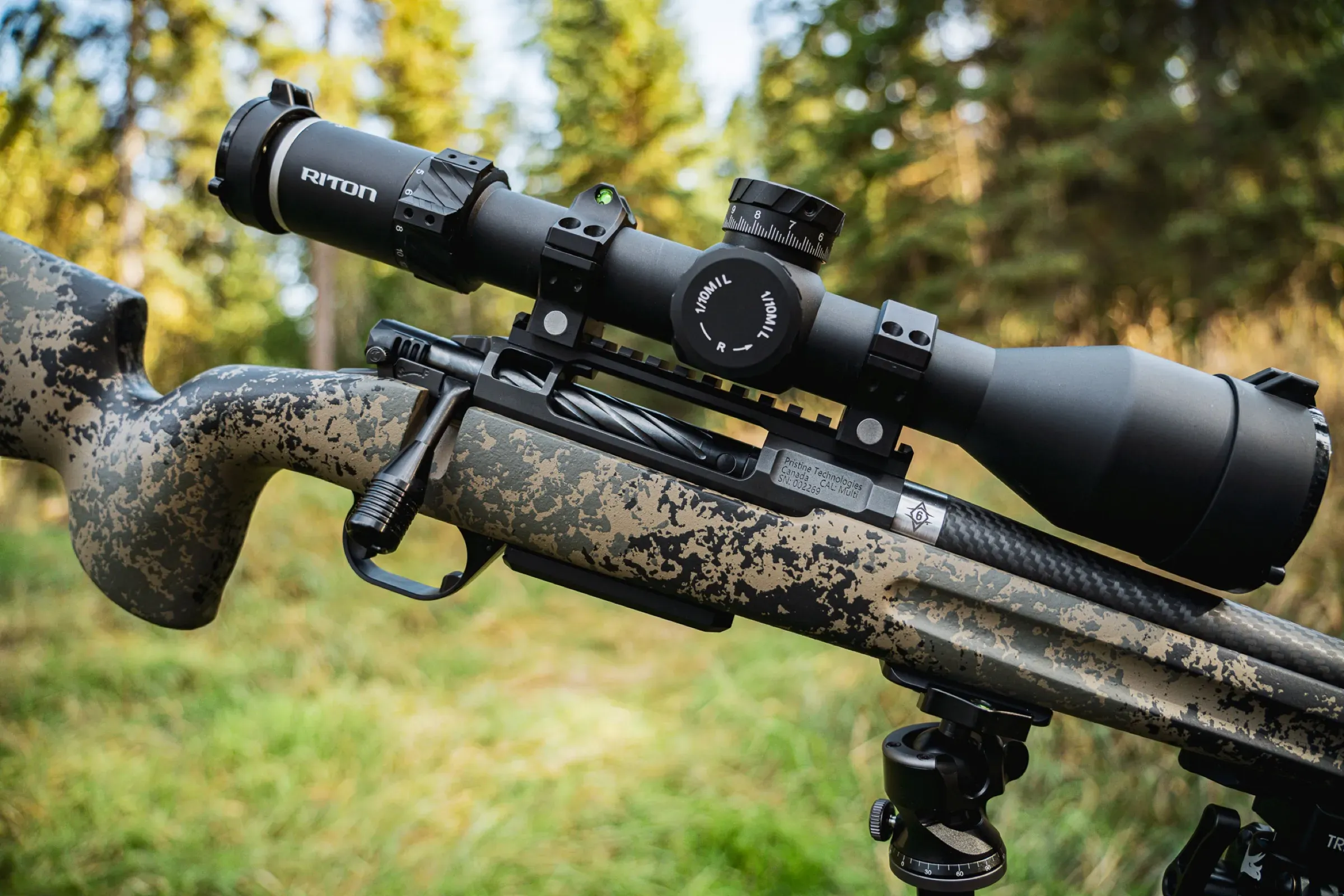
Every Pristine action comes standard with a 20 MOA Picatinny rail that's pinned to the receiver with two dowel pins, not just held on by screws. Pinning keeps the rail from shifting under recoil or after a bump, so your scope stays where you zeroed it. Short actions can also take a 30 or 40 MOA rail if you need more elevation for long range, and we make two-piece 20 MOA bases that fit every Pristine action if you'd rather run bases.
One thing to know: our rails are made for our actions. Standard Remington 700 Picatinny rails and scope bases don't fit a Pristine action, so order the rail or bases from us.
Extraction and ejection
Extraction problems are one of those things you never think about until you've got a stuck case at the worst possible moment. Our two-lug bolt heads run a Sako-style extractor and dual ejectors. The extractor gets a solid bite on the rim, and two ejectors kick the case out cleanly and consistently. We've also improved the treatment on our extractor claws over the last while to make them more resilient. On a hunting rifle that means a fast, sure follow-up shot. On a match rifle it means brass going to the same spot every time instead of dribbling back into the action.
Frictionless Throw
Most bolt actions cock the firing pin with a ramp on the bolt, and the cocking piece drags along that ramp as you lift the handle. A heavy firing pin spring makes for reliable ignition, but it also makes for a stiff bolt lift.
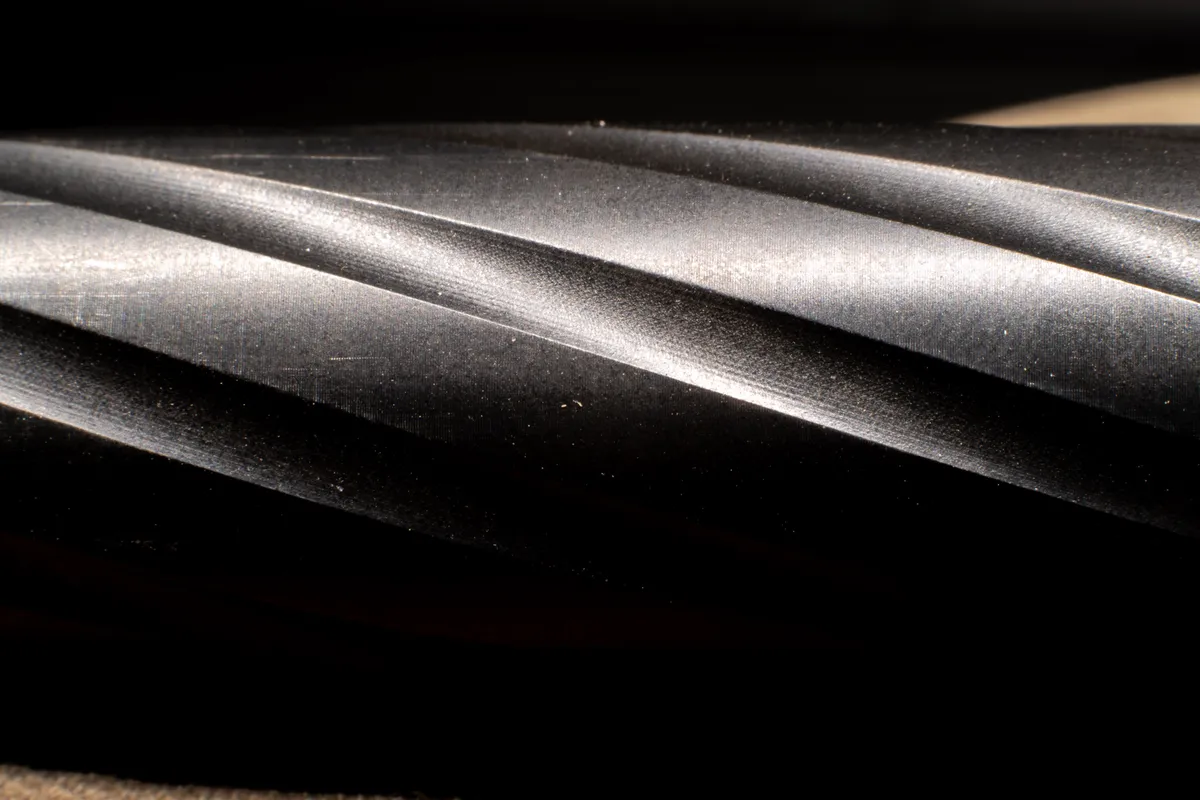
Our Frictionless Throw Technology uses a roller cocking piece, so the cocking piece rolls instead of dragging. You get a light, smooth bolt lift while still running a heavy firing pin spring, and there's no cock-on-close. We wrote a full piece on it, Frictionless Throw Technology, if you want the details.
When a factory action is fine
We'll be straight about this. Not every rifle needs a custom action.
A factory action is a sensible choice when:
- You're building a hunting rifle for whitetail or mule deer at normal ranges and you'll shoot it a few times a year.
- You already own a factory rifle that shoots well and you're happy with it.
- Your budget is tight and the money will do more for you in good glass, good ammo and practice.
- You don't plan on rebarreling or changing cartridges.
A lot of animals have been taken cleanly in Canada and the United States with factory rifles, and that will keep happening. If your rifle is doing what you need, keep shooting it.
Where factory actions start to cost you is when you try to make them into something they weren't built to be. By the time you've paid a smith to true the action, replace the recoil lug, fit a better extractor and sort out a scope mount, you're often close to the price of a custom action, and you still don't have interchangeable bolt heads or a pinned rail.
When a custom action is worth it
A custom action makes sense when the rifle has a job that leans on consistency. In our experience, that looks like:
- Long range. Past 600 yards, small inconsistencies show up as misses. A square, repeatable action and a rail that never moves are a big part of making hits at distance.
- Competition. PRS and NRL rifles get shot a lot, cycled fast and dragged through barricades. A smooth bolt, positive extraction and ejection, and a rigid platform make a real difference over a match.
- Mountain hunting. When you've walked three days for one shot, you want the rifle to work. A lightweight custom action lets you save weight without giving up reliability.
- Rebarreling. If you shoot enough to wear out barrels, a custom action with interchangeable bolt heads means you can rebarrel, or change cartridges, on the same receiver. Your stock, trigger and scope mount stay exactly how you like them.
- Building from scratch. If you're starting a build anyway, a quality action often costs about the same as, or less than, a factory action plus the work to true it.
That last point is where a lot of people land. If you're paying for a build either way, start with the right foundation.
What made in Canada means for your action
Our actions are made in Fort Macleod, Alberta. For our customers in Canada, that means you're dealing with a Canadian shop, pricing in Canadian dollars, and in-stock items shipping in 1 to 2 business days from Alberta. No border, no exchange rate on the price you see, and no guessing about who to call.
It also means we're close to the product. The people who designed the actions machine, fit and check every one, and we use what we hear at the range, in matches and from customers to keep refining it. Since we took over Pristine in 2024, we've spent the last 18 months making rolling changes based on that feedback: moving to the traditional two-lug bolt head on our Lightweight and Heavy receivers, adding the integral recoil lug, thickening the bolt handles, improving tang geometry for aftermarket stocks and chassis, and updating material treatments on the extractor claws and roller cocking pieces. You can read about it in The Evolution of Pristine.
When we build barreled actions, our go-to barrels are IBI and KS, both Canadian-made as well.
For our customers in the United States, we ship actions, barreled actions and barrels south all the time. Actions and barreled actions go through our US importer to your local FFL dealer, and prices are shown in USD. Canadian customers need a valid PAL. Firearm laws vary by province and state, so check yours, and contact the shop if you're unsure. Our licences and regulations page covers the basics.
How to pick a precision rifle action for hunting, PRS and NRL
Start with how you'll use the rifle and work backward. That's the same advice Levi gives on his own builds, and it holds for every rifle we put together. Here's how we'd break it down.
Step 1: Pick the job
Be honest about what the rifle is for. A sheep rifle and a PRS rifle want different things. A rifle that does both well is possible, and Tom's NRL Hunter build is a good example of a rifle that makes a weight class without losing match stability, but you still need to know which side you lean toward.
Step 2: Pick the cartridge, then the action length
The cartridge decides the action length and the bolt face. Short actions suit the 6mm and 6.5 Creedmoor and .308 Winchester. Long actions suit longer and magnum cartridges like the 7 PRC and .300 Win Mag. If you think you might move to a bigger cartridge later, think about that now.
Step 3: Pick the action series
This is where our lineup comes in:
- Lightweight is for mountain and backcountry hunting, where every ounce counts. The Short Action Lightweight receiver is 26 oz and the Long Action Lightweight is 27 oz, with the integral recoil lug, two-lug floating bolt head, pinned rail and Frictionless Throw.
- Heavy is for PRS, NRL and long-range shooting, where extra mass and stiffness help settle the rifle and soak up recoil. The Heavy actions take AICS magazines (the Short Action Heavy has an AW magwell that takes AW and AICS), come in repeater or single shot, and take any standard R700 trigger.
- Classic is our more affordable option, with a pinned recoil lug and a two-lug floating bolt head, or our original multi-lug bolt in the Short Action Classic Multi-lug. The Long Action Classic works with external magazine-fed and BDL stocks, and a Classic is a great first Pristine. The Classic has a slightly wider, stiffer tang, so it may not fit chassis that fully enclose the tang, and some lightweight stocks may need a little fitting.
If you're stuck between them, our article Lightweight, Heavy or Classic? compares them side by side, and the choosing an action page in our help center gives the short version.
Step 4: Check it fits what you already own
Our actions are built on the Remington 700 footprint, so they take Remington 700 triggers (no trigger hanger needed), stocks and chassis. Lightweight and Heavy actions fit R700 stocks and chassis except ones that wrap around and enclose the rear tang top and bottom. Barrels are threaded Savage small shank on the short actions and the Long Action Lightweight, and Savage large shank on the Long Action Heavy and Long Action Classic. If you've got a stock already and aren't sure, send us the details and we'll tell you.
Step 5: Decide on bare action or barreled action
If you have a gunsmith you trust, a bare action is a great start. If you'd rather skip that step, a barreled action comes fitted, chambered and headspaced to the action and tested before it leaves the shop. You drop it in your stock or chassis, install your trigger, mount your scope and go shoot. You can see what's ready to go on our barrels and barreled actions page.
What a few real builds look like
To make this less abstract, here's how this plays out in rifles we've built or shot.
Levi's own NRL Open Heavy rifle is built on our Lightweight short action in 6.5 Creedmoor with an International Barrels blank. He chose that action for rigidity, light weight and repeatability, and because the integral lug and pinned 20 MOA rail take variables out of the build. The rifle needed to come in under 16 lbs to make weight, and it needed to hit targets out past 1,200 yards. He wrote the whole thing up in My Personal Rifle Build.
Our in-stock 6mm Creedmoor barreled action is built on the Short Action Heavy with a 24" stainless M24 contour barrel. It shot a sub-MOA 5-shot group at 100 yards with Hornady Match 108 gr factory ammo, which tells you what a well-fitted action and barrel can do with nothing more than off-the-shelf ammunition.
Customers have done well too. One shoots half-inch five-shot groups with his 6.5 Creedmoor, and another shot a .375" ten-shot group at 100 yards on a Pristine Lightweight. Those results come from the whole rifle and the shooter, not the action alone, but a consistent action is what lets the rest of the rifle show what it can do.
Buying rifle actions for sale online: what to check
When you're comparing rifle actions for sale, from us or anyone else, here's a short list worth running through before you buy:
- Footprint. Will it fit the stocks, chassis and triggers you want to use? An R700 footprint opens up the most options.
- Bolt face options. Can you change the bolt face later, or is it fixed in the bolt?
- Recoil lug. Integral, pinned, or a loose washer you'll need to align on every barrel change?
- Scope mounting. Is the rail pinned? Does it come with the action? What MOA options are there?
- Barrel threads. What tenon does it take, and can you get prefit barrels for it?
- Extraction and ejection. What extractor does it use, and how many ejectors?
- Support. Can you call someone who knows the action inside out? Is there a manual?
- Stock and lead time. Is it on the shelf, or are you waiting months?
Our actions are in stock as we write this; left-hand stock moves quickly, so ask if the one you want shows out. The current lineup and prices are on our bolt actions page, and our Pristine action user manual covers disassembly, torque specs and barrel installs if you want to read up before you order.
Ready to start your build?
If you're weighing up a factory action against a custom one, give us a call or send us a message. We'll tell you honestly whether a custom action makes sense for what you're doing. If you're ready to go, you can order an action straight from the shop, or lay out the rifle you have in mind through our Rifle Builder and Levi will get back to you with recommended parts and a quote. Whether you're in Canada or the United States, we'd be glad to help you build something you trust.
Frequently asked questions
Is a custom rifle action worth it over a factory Remington 700?
It depends on the rifle's job. For a deer rifle shot a few times a year at normal ranges, a factory action is often fine. For long range, PRS or NRL, mountain hunting or a rifle you plan to rebarrel, a custom action gives you consistency, a properly fitted bolt and features like interchangeable bolt heads and a pinned rail that a factory action doesn't have.
Do Pristine actions fit Remington 700 stocks, chassis and triggers?
Yes. Pristine actions are built on the Remington 700 footprint and take any Remington 700 trigger, with no trigger hanger needed. Lightweight and Heavy actions fit R700 stocks and chassis, except chassis that enclose the rear tang top and bottom. Classic actions have a slightly wider tang, so some lightweight stocks may need a little fitting.
Do standard Remington 700 scope rails fit a Pristine action?
No. Pristine rails are made for Pristine actions, so standard Remington 700 Picatinny rails and scope bases won't fit. Every action comes standard with a pinned 20 MOA rail, short actions can also take 30 or 40 MOA rails, and two-piece 20 MOA bases fit every Pristine action.
What is the difference between an integral and a pinned recoil lug?
An integral recoil lug is machined as part of the receiver, so there's nothing to line up when you change barrels. A pinned lug is a separate part located by pins so it goes back in the same place every time. Pristine Lightweight and Heavy actions have an integral lug, and all Classic actions use a pinned lug.
Which precision rifle action is best for PRS and NRL?
Most match shooters lean toward a heavier action, because the extra mass and stiffness help settle the rifle and manage recoil. Our Heavy actions are built for PRS, NRL and long range, with AICS magazine compatibility and repeater or single shot options. For a weight-limited class, a Lightweight action can make sense too.
Can I buy rifle actions in Canada and the United States from Pristine?
Yes. Canadian customers need a valid PAL, and in-stock actions ship from Fort Macleod, Alberta in 1 to 2 business days. US customers order in USD, and actions ship through our US importer to your local FFL dealer. Firearm laws vary by province and state, so check yours and contact the shop if you're unsure.
Can I change cartridges on a custom action without buying a new one?
On a Pristine action, yes. Both our two-lug and multi-lug actions run interchangeable bolt heads, so you can move to a different cartridge family by swapping the bolt head. You'll still need a barrel headspaced to that bolt head and a magazine that suits the new cartridge.
What does Frictionless Throw mean on a Pristine action?
Frictionless Throw Technology uses a roller cocking piece, so it rolls instead of dragging along the cocking ramp as you lift the bolt. That gives you a light, smooth bolt lift while still running a heavy firing pin spring, with no cock-on-close.